Details
near the north side of the Trainig Field Triangle
Chatham, MA
Plaque Content:
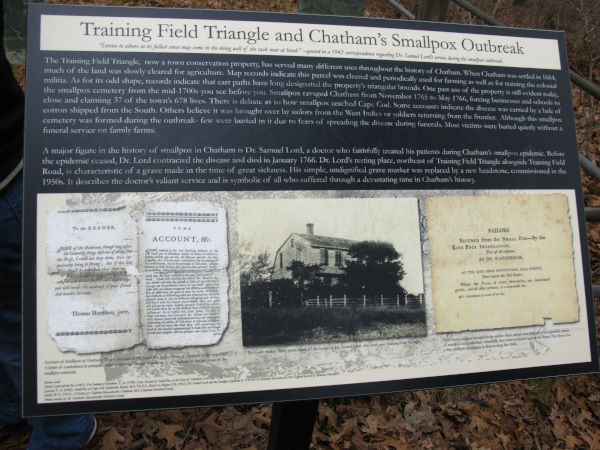
The Training Field Triangle, now a town conservation property, has served many different
uses throughout the history of Chatham. When Chatham was settled in 1664,
much of the land was slowly cleared for agriculture. Map records indicate this
parcel was cleared and periodically used for farming as well as for training the colonial
militia. As for its odd shape, records indicate that cart paths have long designated
the property's triangular bounds. One past use of the property is still evident today,
the smallpox cemetey from the mid-1700s you see before you. Smallpox ravaged Chatham
from November 1765 to May 1766, forcing businesses and schools to
close and claimed 37 of the town's 678 lives. There is debate as to how
smallpox reached Cape Cod. Some accounts believe the disease was carried by a bale of
cotton shipped from the South. Others believe it was brought over by sailors from
the West Indies or soldiers returning from the frontier. Although this smallpox
cemetery was formed during the outbreak - few were buried in it due to fears of
spreading the disease during funerals. Most victims were buried quietly without a
funeral service on family farms.
A major figure in the history of smallpox in Chatham is Dr. Samuel Lord, a doctor who faithfully
treated his patients during Chatham's smallpox epidemic. Before
the epidemic ceased, Dr. Lord contracted the disease and died in January 1766.
Dr. Lord's resting place, northeast of Training Field Triangle alongside Training Field
Road, is characteristic of a grave made in the time of great sickness.
His simple, undignifiedd grave marker was replaced by a new headstone, commissioned in the
1950's. It describes the doctor's valiant service and is symbolic of all
who suffered through a devastating time in Chatham's history.